
























Compleat® Pediatric Original 1.0 was well tolerated and helped children with neurological impairment meet calorie and protein goals without adverse effects
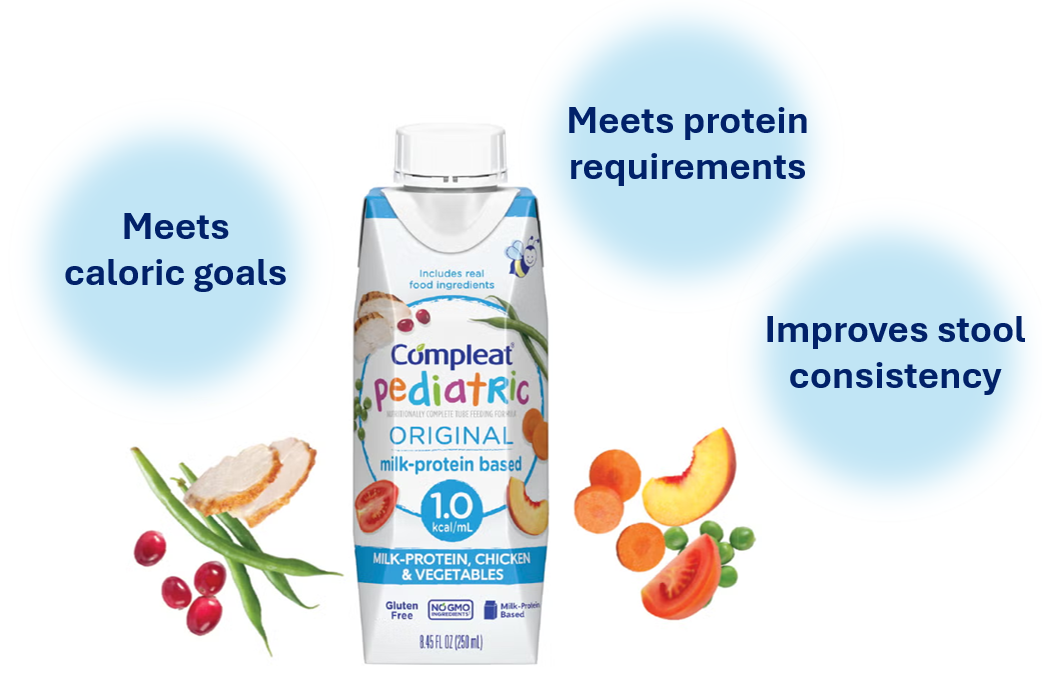
Twenty-one children (ages 1–13) with neurological impairment, all fed via gastrostomy tube, received Compleat® Pediatric, a real-food-ingredient enteral formula, for 7 days in this single-center, prospective, observational study. Children met their calorie and protein goals, and no serious adverse events were reported.
Calorie and Protein Intake
Study Formula, 7-Day Study Period (n=21)
Meeting Nutritional Needs of the Enterally-Fed Child with Neurological Impairment
Minor G, Yamamoto S, Cekola P, Cohen SS, Huhmann MB, Araujo Torres K. J Clin Nutr Diet. 2020;6(4):3.
Introduction
Up to 90% of children with developmental delays have some degree of feeding disorder resulting from neurological or neuromuscular impairment, physical anomalies, or sensory and behavioral food aversions.1 These children frequently have gastrointestinal disorders that interfere with oral food intake and, as a result, enteral tube feedings are sometimes used. Some parents of tube-fed children seek to provide foods via feeding tube which they believe are more healthful and may choose to blenderize food at home. In a growing trend, more commercially-blenderized food-based commercial formulas have become available. We hypothesized that a commercial enteral formula containing ingredients from real foods can meet estimated nutritional needs of children with neurological impairment without a significant increase in GI intolerance.
Objectives
Primary objective assessed meeting daily calorie goals; secondary objectives assessed meeting protein-intake, formula intolerance, and quantifying adverse events.
Design
This was a single-center, prospective, observational study of tube-fed children. Participants (n=21, 1-13 years) had enteral access via gastrostomy tube; were tolerant of their pre-study enteral feeding; and received ≥90% of nutritional needs via EN for at least 9 days.
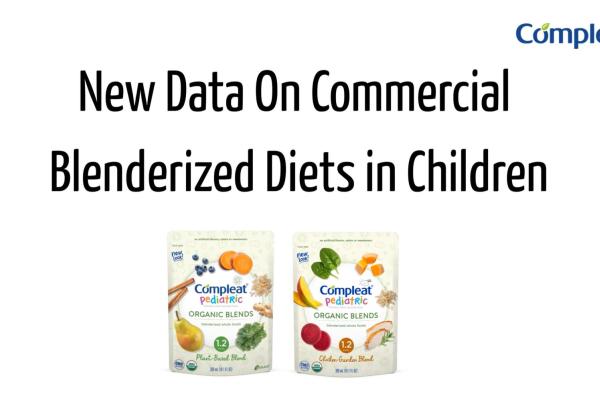
Study formula (SF) provided 1.0 kcal/mL, 15%, 51% and 34% of calories from protein, carbohydrate and fat, respectively, and contained ingredients from foods such as tomatoes, peas, green beans, peaches, chicken, and cranberry juice (COMPLEAT® PEDIATRIC, Nestlé Health Science, Bridgewater, New Jersey, USA). Children received the study formula for 7 days.
Study Procedures
Following a nutritional assessment by an RDN to establish calorie and protein needs, consent and enrollment, caregivers were given a diary to record daily formula intake of their child's current enteral formula. Starting on study day 0, children switched to SF, and continued for 7 days. The children were fed exclusively the SF via a feeding tube, according to the nutrition prescription.
In a daily diary, caregivers logged the quantity of formula consumed; tolerance (i.e. stool frequency and consistency, incidence of vomiting, flatulence) and incidence of adverse events. Each day, caregivers also rated their child's level of irritability/mood based on a 5-point scale. A physician determined whether any reported adverse events were related to the feeding of the SF.
Results
Twenty-one children fed via G-tube were enrolled; one child was withdrawn early due to a single episode of emesis.
Calorie and Protein Intake: On average, 60% (n=12) of children met at least 90% of calorie goals, and 90% (n=18) met at least 70% of the calorie goals. In addition, 90% (n=18) of children met their daily protein goals. Fifteen (75%) children received at least 90% of protein goals without exceeding 110% of their calorie goals.
Gastrointestinal Events: The mean number of stools per child per day for PSF and SF was unchanged, with a 20% decrease in the mean number of hard-to-pass stools and reports of flatulence. Watery stools and reports of vomiting remained unchanged. Out of 20 children, five experienced at least one gastrointestinal adverse event on one day of the study. These adverse events, however, were either unrelated or unlikely to be related to the SF based on medical provider assessments. For all children, tube feedings were continued through the entire study interval.
Conclusion
There is a small but growing body of evidence that demonstrates enteral formulas with real food ingredients are safe and can help improve GI tolerance compared to standard commercial formulas.2-9 Some parents of children who have transitioned to home blenderized tube feeding report fewer symptoms of tube feeding intolerance (i.e. reflux, gagging, diarrhea, and constipation).10 Some tube-fed children on home blenderized tube feedings (BTF) also met nutrient or growth goals, though to do so typically required feeding a greater volume of BTF compared to standard commercial formulas (SCF).2,5,6
The commercially-made, food-based formula tested was a safe, convenient, and nutritionally-balanced enteral feeding for children with NI and associated feeding disorders. Calorie and protein goals were achieved without notable intolerance and no reports of serious adverse events. The SF is a practical, nutritionally-complete, real-food option for enteral feedings in children with NI.
For children with feeding disorders requiring enteral nutrition, the results demonstrate that a commercial enteral formula that includes fruit and vegetable ingredients can meet calorie and protein goals without increasing adverse events. A majority of these children (60%) met their estimated daily protein goals without exceeding calorie needs, so the SF met their needs efficiently and effectively.
Which children use enteral nutrition?
- There are nearly 200,000 pediatric patients on home enteral nutrition in the US.11
- Most are children with developmental delays and feeding disorders due to neurological impairment (NI) or neuromuscular conditions.1
- Children with NI frequently have feeding and swallowing problems and GI dysfunction that interferes with normal nutrition.1, 12
There is a growing trend towards feeding real foods and their components.
- There is growing evidence that real food in enteral feeds can help improve GI tolerance.2, 5-9
- Improved tolerance likely results from increased viscosity and from development of a more diverse microbiome, which follows intake of varied nutrients and fiber in a diet based on real foods.6