




















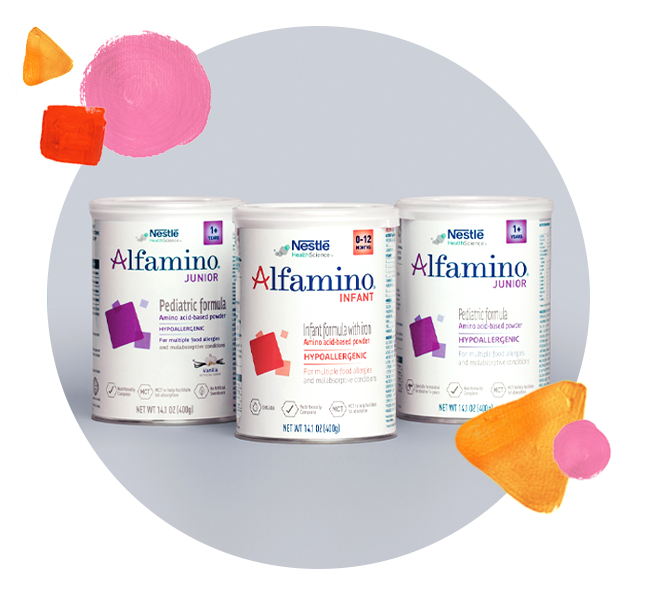
Alfamino® Meets American Academy of Pediatrics Criteria for Hypoallergenicity in Children With Confirmed Cow's Milk Allergy
33 subjects completed both double-blind placebo-controlled food challenges (DBPCFCs). No subjects experienced an allergic reaction to either the test formula or control formula during the DBPCFCs.
Evaluation of Hypoallergenicity of a New, Amino Acid-Based Formula
Nowak-Wegrzyn A, Czerkies LA, Collins B, Saavedra JM. Clinical Pediatrics. 2015;54(3):264-272.
Background
Cow's milk allergy (CMA) is a major food allergy in infancy and childhood. The American Academy of Pediatrics (AAP) defines a formula as hypoallergenic when clinical testing demonstrates, with 95% confidence, that at least 90% of individuals with confirmed CMA will not react under double-blind, placebo-controlled conditions.
Objective
To determine whether a new amino acid-based formula (AAF; test formula, subsequently marketed as Alfamino®) met AAP criteria for hypoallergenicity in infants and children with documented CMA.
Study Design
- Design: Randomized, double-blind, active-controlled, crossover food-challenge study followed by a 7- to 9-day at-home open challenge with the test formula.
- Population: Infants and children with documented CMA, recruited at 6 U.S. sites. Thirty-seven subjects were enrolled; mean age was 4.6 years.
- Intervention: Double-blind placebo-controlled food challenges (DBPCFCs) with both the test AAF and a commercial control AAF (Neocate®), administered 2–7 days apart in randomized sequence.
- DBPCFC exposure: Total planned formula volume was 180 mL for subjects ≤1 year and 240 mL for subjects >1 year, with standardized assessment of skin, respiratory, gastrointestinal and cardiovascular signs/symptoms.
- Open challenge: Subjects who passed both DBPCFCs were instructed to consume at least 8 oz/day of the test formula for 1 week, while recording intake, stool characteristics, GI symptoms, potential allergic symptoms and adverse events.
- Primary endpoint: Demonstration that the lower bound of the one-sided 95% confidence interval for the proportion without allergic reactions was at least 90%.
Formula Comparison
Per 100 kcal | Control AAF | Test AAF (Alfamino®) |
|---|---|---|
Protein source | Amino acids | Amino acids |
Protein | 3.1 g (12.4% kcal) | 2.8 g (11.2% kcal) |
Fat | 4.5 g (41% kcal) | 4.9 g (45% kcal) |
MCT, % of fat | 33% | 43% |
Carbohydrate | 11.7 g (47% kcal) | 11.2 g (44% kcal) |
Carbohydrate source | Corn syrup solids | Corn syrup solids, potato starch |
MCT = medium-chain triglycerides. Both formulas also contained ARA and DHA.
Results
33 subjects completed both DBPCFCs. No subjects experienced an allergic reaction to either the test formula or control formula during the DBPCFCs.
- AAP hypoallergenicity criterion achieved: the lower bound of the 95% confidence interval for hypoallergenicity was 91.3%, exceeding the AAP requirement of 90%.
- Open challenge: all 33 DBPCFC completers participated. Thirty consumed at least 8 oz of test formula on at least 5 days.
- GI tolerance: no unusual stool patterns or characteristics, flatulence, or spit-up were reported during the open challenge.
- Reported events: four subjects reported vomiting on at least one occasion, attributed to palatability. One subject reported perioral erythema, one itchy skin on the back, and one a mild stomachache. These events were self-resolving and did not lead to cessation of test formula.
- Safety: no serious adverse events were reported.
Discussion
The randomized crossover DBPCFC design directly assessed acute allergic reactivity to the test and control AAFs in children with well-documented CMA. The authors report that the test formula met the prespecified AAP hypoallergenicity criterion. The subsequent home challenge provided additional short-term observations on intake and tolerance.
Study considerations
- The primary hypoallergenicity analysis was based on the 33 subjects who completed both DBPCFCs. Four of 37 randomized subjects discontinued their first DBPCFC because of formula taste; no signs of a positive allergic reaction were observed in those subjects.
- The open challenge was short (7–9 days) and conducted at home rather than under controlled challenge conditions.
- The study was supported by Nestlé Health Science. Two authors were employees of Nestlé Nutrition.
The test amino acid-based formula met the AAP criteria for hypoallergenicity and offers a free amino acid formula option for infants and children with severe cow's milk allergy who may require an AAF.