
























Alfamino® Supported Similar Daily Weight Gain to a Commercially Available Amino Acid-Based Formula in Healthy Term Infants
119 infants completed the study per protocol: 60 Control and 59 Test. Mean daily weight gain was similar between groups.
Assessment of Growth of Infants Fed an Amino Acid-Based Formula
Corkins M, Czerkies LA, Storm HM, Sun S, Saavedra JM. Clinical Medicine Insights: Pediatrics. 2016;10:3-9.
Background
Amino acid-based formulas (AAFs) may be used when infants require a formula without intact cow's milk protein, including infants who do not tolerate an extensively hydrolyzed formula. A new AAF containing 43% of fat as medium-chain triglycerides (MCTs) had previously been shown to meet AAP hypoallergenicity criteria. This study evaluated whether the new AAF supports normal growth in healthy, exclusively formula-fed, full-term infants.
Objective
Primary: compare growth, expressed as daily weight gain, in infants consuming the new AAF (Test) versus a commercially available AAF (Control). Secondary objectives included length, head circumference, formula tolerance and adverse events.
Study Design
- Design: Randomized, controlled, double-blind, multicenter, parallel-group clinical trial at 17 U.S. sites.
- Population: Healthy, full-term (>37 weeks gestation), exclusively formula-fed infants with birth weight 2,500–4,500 g; enrolled at 0–17 days of age.
- Feeding period: Assigned formula was the exclusive source of nutrition through 112 days of life.
- Study visits: 14, 28, 56, 84 and 112 days; weight, length and head circumference were assessed and compared with WHO standards.
- Tolerance assessment: Caregivers recorded formula intake, stool characteristics, flatulence, spit-up/vomiting, sleep and mood for 2 days before each visit.
- Laboratory subset: Serum albumin and plasma amino acids were measured at 84 days in 38 infants.
- Primary outcome: Daily weight gain from 14 ± 3 days to 112 ± 3 days.
Formula Snapshot
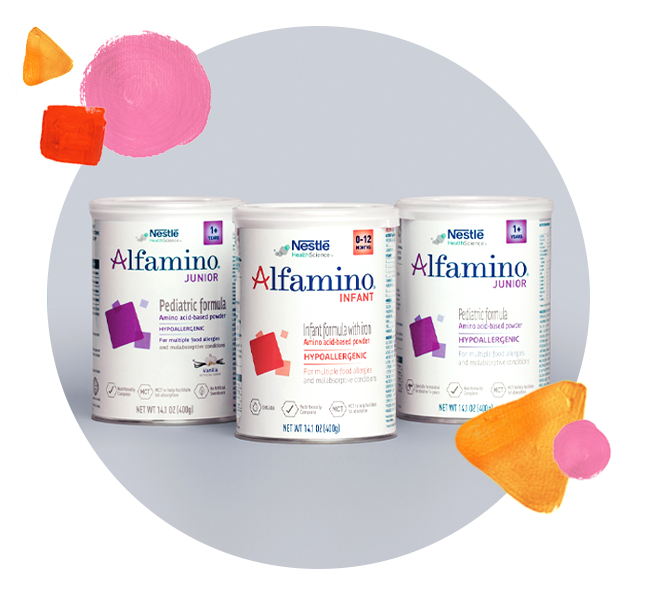
Per 100 kcal | Control AAF | Test AAF (Alfamino®) |
|---|---|---|
Protein source | Amino acids | Amino acids |
Protein | 3.1 g; 12.4% kcal | 2.8 g; 11.2% kcal |
Fat | 4.5 g; 41% kcal | 5.0 g; 45% kcal |
MCT, % of fat | 33% | 43% |
Carbohydrate | 11.7 g; 47% kcal | 11.12 g; 44% kcal |
Osmolality | 340 mOsm/kg water | 330 mOsm/kg water |
Key Findings
119 infants completed the study per protocol: 60 Control and 59 Test. Mean daily weight gain was similar between groups.
Outcome | Control | Test | Comparison |
|---|---|---|---|
PP weight gain, both sexes | 27.26 ± 4.92 g/day | 27.42 ± 6.37 g/day | P = 0.8812 |
ITT weight gain, both sexes | 27.99 ± 5.32 g/day | 27.30 ± 6.51 g/day | Not significant |
Length gain | 1.07 mm/day | 1.04 mm/day | P = 0.398 |
Formula intake | 28.75 ± 11.23 oz/day | 29.34 ± 9.68 oz/day | Not significant |
Stool frequency | 2.03/day | 3.36/day | P = 0.001 |
- Growth: Daily weight gain did not differ significantly between formulas for girls, boys or both sexes in the ITT or PP populations. The authors note that mean differences between formulas fell within 3 g/day.
- Baseline-adjusted findings: Girls in the Test group were smaller than Control girls beginning at birth and baseline. When birth weight was taken into account, no significant differences were observed between groups for weight-for-age z-scores or percentiles.
- Other anthropometrics: Daily length gain was not significantly different. No significant head-circumference differences were seen in the PP population.
- Tolerance: Formula intake, flatulence, spit-up/vomiting, mood and sleep did not differ significantly. Test-fed infants had more frequent stools; stool consistency did not differ significantly.
- Safety/nutritional measures: Total adverse events did not differ between groups. Serum albumin and plasma amino acids in the assessed subset were within normal limits for both groups.
Study Context and Limitations
- The study enrolled healthy term infants, not infants with the clinical conditions for which AAFs are typically used; the authors state that whether the observed findings would also occur in intended populations remains unknown.
- Overall dropout was 44% (47% Test; 40% Control), with no significant difference in dropout numbers between groups. The authors discuss the smell and taste of AAFs as a possible contributor.
- The study evaluated growth through approximately 4 months of age; long-term effects could not be determined.
- The study was funded by Nestlé Health Science. Nestlé Health Science developed the Test AAF; several authors disclosed employment, oversight payment or statistical consulting relationships with Nestlé.
The 4-month multicenter trial showed similar mean daily weight gain between the Test AAF (Alfamino®) and a commercially available AAF. The authors concluded that the new AAF supports growth similarly to the comparator and is another option for infants who may require an AAF.