






















Extensive HA® has been clinically proven to be hypoallergenic and meets the AAP criteria for hypoallergenicity.
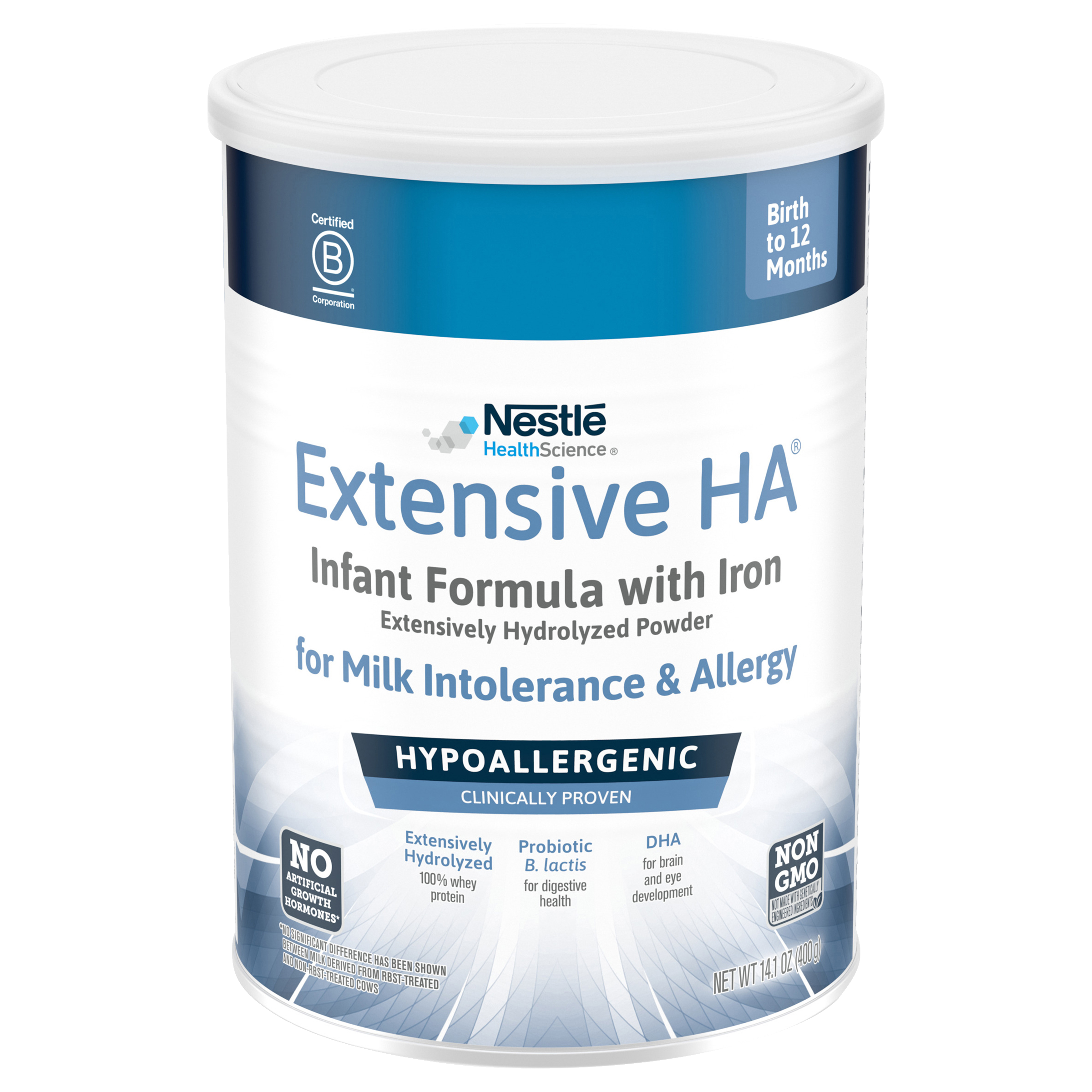
Extensive HA® has been clinically studied and has demonstrated efficacy in the dietary management of infants with cow’s milk protein allergy.
Hypoallergenicity of a New Extensively Hydrolyzed 100% Whey-based Formula Containing Probiotics
Nowak-Wegrzyn et al., J Allergy Ther 2015,6:5.
Objectives
The American Academy of Pediatrics (AAP) defined an infant formula as hypoallergenic if it ensures with 95% confidence that 90% of infants/children with confirmed cow’s milk protein allergy (CMPA) do not react under double-blind, placebo-controlled conditions. The aim of this study was to determine whether a new 100% whey protein extensively hydrolyzed formula containing B. lactis meets AAP hypoallergenicity criteria.
Background
The AAP recommends the use of a hypoallergenic infant formula in non-breastfed infants with existing allergic symptoms. Extensively hydrolyzed infant formulas use cow’s milk protein as their protein source; however, unlike standard infant formulas, they undergo processing where the protein is broken down to smaller peptides with molecular weights lower than the intact protein, minimizing predominantly IgE-binding allergenic epitopes that could cause immediate allergic reactions in CMPA infants.
Statistical Methods
The primary objective of this clinical trial was to determine whether extensively hydrolyzed whey-based formula met the AAP criteria for hypoallergenicity, demonstrating with 95% confidence that 90% of infants or children with confirmed CMPA will not develop allergic reactions based on a double-blinded, placebo-controlled food challenge (DBPCFC).
Methods
Children with CMPA were randomized to a DBPCFC with Extensive HA® (Test) and Nutramigen® with Enflora™ LGG® (Control), both extensively hydrolyzed formulas, in a cross-over fashion. CMPA was confirmed by elevated serum cow’s milk (CM)-IgE levels, positive skin prick test to CM extract, or positive CM oral challenge within 6 months prior to enrollment. Allergic reactions in the DBPCFC’s were assessed using a comprehensive scoring system. If both challenges were tolerated, subjects participated in an at-home week-long Test open challenge.
Control Formula (Nutramigen® LGG™) | Test Formula (Extensive HA®) | |
|---|---|---|
Protein | 100% casein, extensively hydrolyzed | 100% whey, extensively hydrolyzed |
Fat | Palm olein, soy oil, coconut oil, high oleic sunflower oil, DHA & ARA | MCT, soybean oil, high oleic sunflower oil, high sn-2 palmitate palm oil, DHA & ARA |
Carbohydrate | Corn syrup solids, modified corn starch | Maltodextrin, potato starch |
Probiotic | 106 cfu/g Lactobacillus GG | 106 cfu/g Bifidobacteria lactis |
Results
77 children (3.30 ± 2.98 years old) with confirmed CMPA were enrolled. Of the 68 subjects participating in the Test DBPCFC, one had an allergic reaction (lower bound 95% confidence interval of 0.921 for Test), while 4 out of 75 subjects participating in the DBPCFC with the Control had an allergic reaction. The Test formula met the AAP hypoallergenicity criteria. Average formula intake during the Test open challenge was 250ml/day. One 6-year old subject reported angioedema, atopic dermatitis, rash around the eyes, and red swollen eyes on open challenge Day 6. This subject did not report any symptoms during the Test DBPCFC, was not exclusively formula-fed during the open challenge, and did not discontinue formula during the open challenge.
(n=1)
(n=4)
Discussion
Hypoallergenic infant formulas are intended for use by infants with CMPA. For an infant formula to be considered hypoallergenic, the AAP developed guidelines and recommendations. This clinical study demonstrated that the 100% whey extensively hydrolyzed Test formula meets AAP hypoallergenicity criteria. 98.5% of the Test subjects did not have any allergic reactions. With 1 out of 68 subjects showing a reaction to the Test formula, the lower bound 95% confidence interval was 0.921 (92.1%) which is greater than the required 0.90 level for the AAP criteria of hypoallergenicity of a formula. The AAP acknowledges that at least 90% of infants and children with CMPA tolerate extensively hydrolyzed formulas as well as the more recently introduced free amino acid-based infant formulas.
Extensive HA® extensively hydrolyzed formula meets the AAP criteria for hypoallergenicity and can be recommended for the management of CMPA.