





























Desai, A., Henrikson A., Allen F., Kumar P., Veda Samhitha, S., Araujo Torres, K. Pediatric Gastroenterology and Nutrition. 75(S1): S293, October 2022
Introduction:
The prevalence of home enteral nutrition (HEN) as part of post-acute care in the US has increased in recent decades due to its clinical and economic benefits.1 Healthcare professionals, patients, and caregivers are requesting tube feeding formulas including more real food and recognizable ingredients.2,3 Commercially blenderized tube feeding formulas (CBTF) containing a variety of real foods may be suitable for patients with difficulty tolerating standard tube feeding formulas (STD-TF).3
Objective:
To describe patient characteristics and clinical outcomes among pediatric patients who received CBTF compared to those receiving a plant-based STD-TF formula in post-acute care.
Methods:
This was a retrospective observational study, conducted using data from the Decision Resources Group Real World Evidence Data Repository, which covers 98% of US health plans and includes medical and pharmacy claims. Patients 1-14 years of age, with a prescription of either CBTF (Compleat® Pediatric Organic Blends, Nestlé HealthCare Nutrition, US) or STD-TF (Kate Farms® Pediatric Standard 1.2, Kate Farms Inc., US) between Jan 2018 and Dec 2020 were included. The index date was defined as the date of hospital discharge. GI intolerance symptoms were compared between CBTF and STD-TF group at 84 days post-index.
Patient Characteristics:
The study included 1064 children (42% female; mean age 5.05 years) from all US regions. The most common diagnoses pre-index were diseases of the digestive system (83%), respiratory diseases (80%), and congenital conditions (72%). Mean Charlson Comorbidity Index score was 1.7 among patients with comorbidities. The most common comorbidities were chronic pulmonary disease (30%), paraplegia and hemiplegia (27%) and cerebrovascular disease (7%). No significant difference in concomitant medication use was observed for GI drugs (anti-diarrheals, anti-emetics, laxatives and others) and anti-infective drugs.
Results:
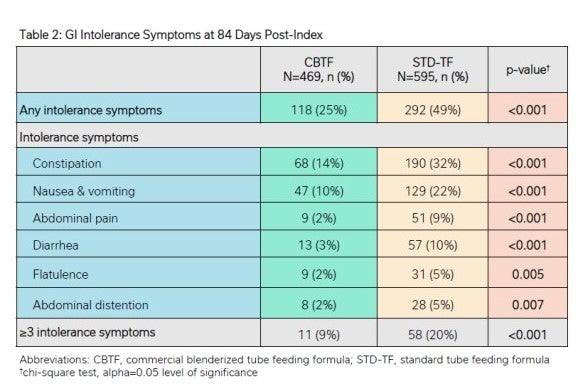
Significantly fewer patients experienced any GI intolerance symptoms at 84 days post-index while receiving the CBTF formula (25%) than STD-TF (49%) (p<0.001). This reduction in GI intolerance was maintained for specific intolerance symptoms including constipation (p<0.001), nausea and vomiting (p<0.001), abdominal pain (p<0.001), diarrhea (p<0.001), flatulence (p=0.005) and abdominal distension (p=0.007) at 84 days post-index (Table 2).
Conclusion:
The use of CBTF containing a variety of real foods was well tolerated in pediatric patients compared to STD-TF formulas. Significant reductions in GI intolerance symptoms were observed among children receiving CBTF compared to STD-TF formulas, demonstrating clinical benefits of real food tube feeding formulas in post-acute care patients.
References:
1. Mundi MS, et al. Nutr Clin Prac. 2017;32(6):799-805.
2. Gramlich L, et al. Nutrients. 2018;10(8).
3. Boullata JI, et al. JPEN J Parenter Enteral Nutr. 2017;41(1):15-103.
To access the poster presented at ASPEN 2023, click here.
To access the poster presented at NASPGHAN 2022, click here.
Study summary prepared by Nestlé Health Science. All trademarks are owned by Société des Produits Nestlé S.A., Vevey, Switzerland. ©2022 Nestlé Health Science. All rights reserved. Kate Farms® Pediatric Standard 1.2, are owned by Kate Farms Inc, US