




























Safety and Usage of an Amino Acid-Based Formula for Infants: Results for a Post Market Surveillance Study
Cekola P (2021), Safety and Usage of an Amino Acid-based Formula for Infants: Results from a Post Market Surveillance Study.
J Clin Nutr Diet Vol: 7 No: 8.
Introduction:
Cow’s milk protein allergy (CMPA) is one of the major food allergies experienced by infants and children. [4,5] Extensively hydrolyzed formulas (EHF) are recommended by the American Academy of Pediatrics (AAP) for the dietary management of formula-fed infants who are allergic or intolerant to intact cow’s milk-based infant formula (CMF); however, a subgroup of these infants cannot tolerate EHFs. [6] For these infants or those with multiple food allergies who exhibit poor growth, amino acid-based formulas (AAFs) have been shown to be effective, well-tolerated, and support growth [7-12]. AAF are also utilized in the management of malabsorption syndromes, short bowel syndrome (SBS)[13] multiple food allergies [9-14] eosinophilic gastrointestinal (GI) disorders [15-17] gastroesophageal reflux disease (GERD)[18] and food protein induced enterocolitis syndrome (FPIES).[19] The present study is the first post-market surveillance (PMS) program of a hypoallergenic amino acid-based infant formula, which provides real-world safety and monitoring data. The primary aim of the PMS program reported here was to further evaluate the safety of a commercialized hypoallergenic AAF in a real-world, routine, clinical practice setting by assessing the frequency and nature of AE in infants fed the formula. The secondary objectives were to describe demographic and clinical characteristics of infants fed the AAF and their complementary food intake, as well as caregiver satisfaction with the formula.
Methods:
This prospective, non-randomized, PMS program for the hypoallergenic amino acid-based Alfamino® Infant formula (HAA) was conducted at 30 sites with wide geographic representation across the US. Eligibility for enrollment was determined according to the following criteria: 1) infants ≤ 12 months consuming HAA formula at the time of enrollment or those for whom consumption of the formula was planned, and 2) at least one parent/caregiver to provide prior written informed consent (ICF). Infants who were <37 weeks of corrected gestational age (CGA) at the time of enrollment were excluded from participation in the surveillance program. Enrolled infants were followed for up to four months or until discontinuation of HAA formula. Each infant was followed by their HCP for routine clinical care from February 2017 to May 2018. Subjects were not randomized as this was a prospective, PMS program. Data were collected at enrollment and at any follow-up visit with the primary HCP up to four months thereafter. The diagnoses for which the infants’ were using HAA formula was documented. Starting at initiation of HAA formula, adverse events were recorded. At follow-up visits throughout the study, subjects’ consumption of HAA formula and complementary foods, anthropometrics, AE, any change in the symptoms or diagnosis that led to the use of HAA formula, concomitant medications, and caregiver satisfaction were documented. AE could have been illness, signs or symptoms that occurred or worsened during the course of the study, and were reported as non-serious or serious. Serious adverse events (SAE) were defined as fatal or life-threatening events causing permanent harm or requiring/extending inpatient hospital treatment, or which was considered medically relevant by the physician, which may or may not have had a relationship to treatment. Other non-serious events were documented as an AE. HCPs were required to document and assess AE for relationship to the formula, categorized as “Unrelated,” “Unlikely,” “Probable,” or “Definite.”
Results:
Of 144 subjects enrolled, 88 (61%) were followed for the intended four-month surveillance period. Of the infants enrolled, the primary diagnosis leading to the use of HAA formula was CMPA (n=100, 69%), followed by malabsorption/maldigestion in 5 subjects (3%), and other diagnoses were reported in 39 subjects (27%), including milk protein intolerance, failure to thrive (FTT), reflux and GERD. Fifty-nine percent of enrolled subjects (n=84) met one or more criteria for severe CMPA allergy. Six SAE were reported in six subjects, three of which had severe CMPA. Of all of the SAE, the causal relationship to the product was reported as “Unrelated” or “Unlikely” relationship to HAA formula. There were no reports of anaphylaxis during this study. In four of the six SAE (67%), HAA use continued with no change, which included one SAE in an infant with severe CMPA. HAA use was withdrawn after one SAE (17%), and one SAE (17%) required the infant to transition from consuming HAA orally to via nasogastric tube; the latter two interventions occurred in infants with severe CMPA. Non-serious AE were not reported in 60% (n=86 of 144) of all subjects and in 63% (n=53 of 84) of those with severe CMPA. In all subjects and within the severe CMPA group, 40% and 37%, respectively, reported non-serious AE over the course of surveillance.
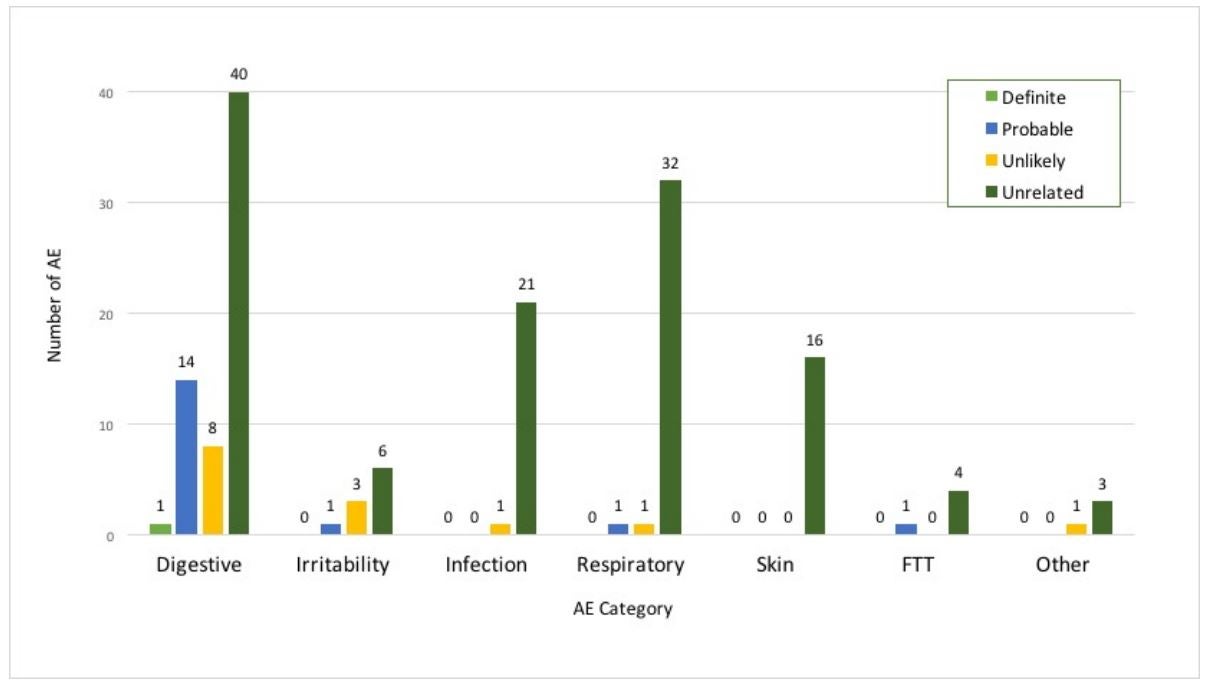
In 78% (n=122) of all subjects, the AE was deemed to be “Unrelated” to HAA usage by the HCP. Similarly, in subjects with severe CMPA, 74% (n=67) of AE were determined to be “Unrelated” to HAA consumption. One subject with CMPA was described as having several occasions of mild emesis. This AE was determined to have a “Definite” relationship to HAA and was attributed to switching to HAA from an extensively hydrolyzed formula; the subject was subsequently switched back to the previous formula. Seventeen AE in 13 subjects (eight with severe CMPA) were categorized as having a “Probable” relationship to HAA; the majority (82%) of these AE was reported as emesis, reflux, diarrhea and constipation. At each follow-up visit, caregiver satisfaction with HAA was assessed. Eighty percent (n=91) of caregivers were satisfied with HAA, and 5% of caregivers reported mixed satisfaction. In the CMPA subgroup, 82% (n=69) of caregivers reported they were satisfied with HAA and 5% reported mixed satisfaction.
Figure 1: Adverse Events (AE), by Symptom Category and Relationship to Hypoallergenic Amino Acid-based Infant formula.
Discussion:
This is the first of its kind post market prospective surveillance program and adds to the record of safety for the hypoallergenic amino acid-based infant formula HAA, demonstrating the safety of the formula for a subject population that included a high incidence of severe CMPA. The monitoring of SAE addresses a higher degree of safety in this vulnerable population of infants. Of the six SAE reported, only one resulted in discontinuation of the study formula and all were deemed either “Unrelated” or “Unlikely” to be related to the HAA formula. There were no cases of anaphylaxis reported in a subject population overwhelmingly diagnosed with CMPA, adding substantiation of the formula’s safety for infants requiring AAF for allergy management. Many symptoms recorded in the subjects’ symptom history were consistent with AE recorded. In our study, gastrointestinal symptoms were the most frequently reported AE. This is consistent with findings from a review by Vandenplas, who found that regurgitation, constipation, and crying or distress are events common in infancy [20]. We found most AE were deemed “Unrelated” to the formula and did not trigger discontinuation of HAA formula. In our study, caregivers in both the overall and CMPA subgroup reported high levels of satisfaction with the formula at similar rates of 80% and 82%, respectively.
Conclusion:
HAA consumption by infants with CMPA, severe CMPA and malabsorptive conditions does not present with safety concerns and is associated with a high degree of caregiver satisfaction. Use of HAA in infants demonstrated no unexpected symptoms in this PMS program. SAE reported were not related to formula use and 89% of AE were classified as either “Unrelated” or “Unlikely” to be related to the formula. The AE reported in this study are common among infants with the diagnoses represented in this study. AAFs provide a vital source of nutrition for infants who are unable to tolerate extensively hydrolyzed infant formulas. Additional long-term post-market surveillance studies are needed to provide a more comprehensive view of the real-world experience of infants requiring specialized formulas to manage complex diagnoses.
References : 4. Høst A, , et al. Arch Dis Child. 1999;81(1): 80-84. 5. Sampson HA. J Allergy Clin Immunol. 1999;103(6):981-989. 6. American Academy of Pediatrics. Committee on Nutrition. Hypoallergenic infant formulas. Pediatrics. 2000;106(2 Pt 1): 346-349. 7. Corkins M, et al. Clin Med Insights Pediatr. 2016;10:3-9. 8. Burks W, et al. J Pediatr. 2008;153(2):266-271. 9. Isolauri E, et al. J Pediatr. 1995;127(4):550-557. 10. Koletzko S, et al. J Pediatr Gastroenterol Nutr. 2012;55(2):221-229. 11. Sampson HA, et al. Pediatrics. 1992;90(3):463-465. 12. Vanderhoof JA. J Pediatr Gastroenterol Nutr. 2008;47 Suppl 2:S60-61. 13. Nucci AM, et al. Nutr Clin Pract. 2018;33(4):528-538. 14. Sicherer SH, et al. J Pediatr. 2001;138(5):688-693. 15. Nowak-Węgrzyn A, et al. J Allergy Clin Immunol. 2017;139(4): 1111-1126.e1114.
Study summary prepared by Nestlé Healthcare Nutrition. Download PDF of Summary
The complete study may be accessed online: https://clinical-nutrition.imedpub.com/safety-and-usage-of-an-amino-acidbased-formula-for-infants-results-from-a-post-market-surveillance-study.pdf
Unless otherwise noted, all trademarks are owned by Société des Produits Nestlé S.A., Vevey, Switzerland. ©2022 Nestlé Health Science. All rights reserved.