




























Immunonutrition vs. Standard Nutrition for Cancer Patients
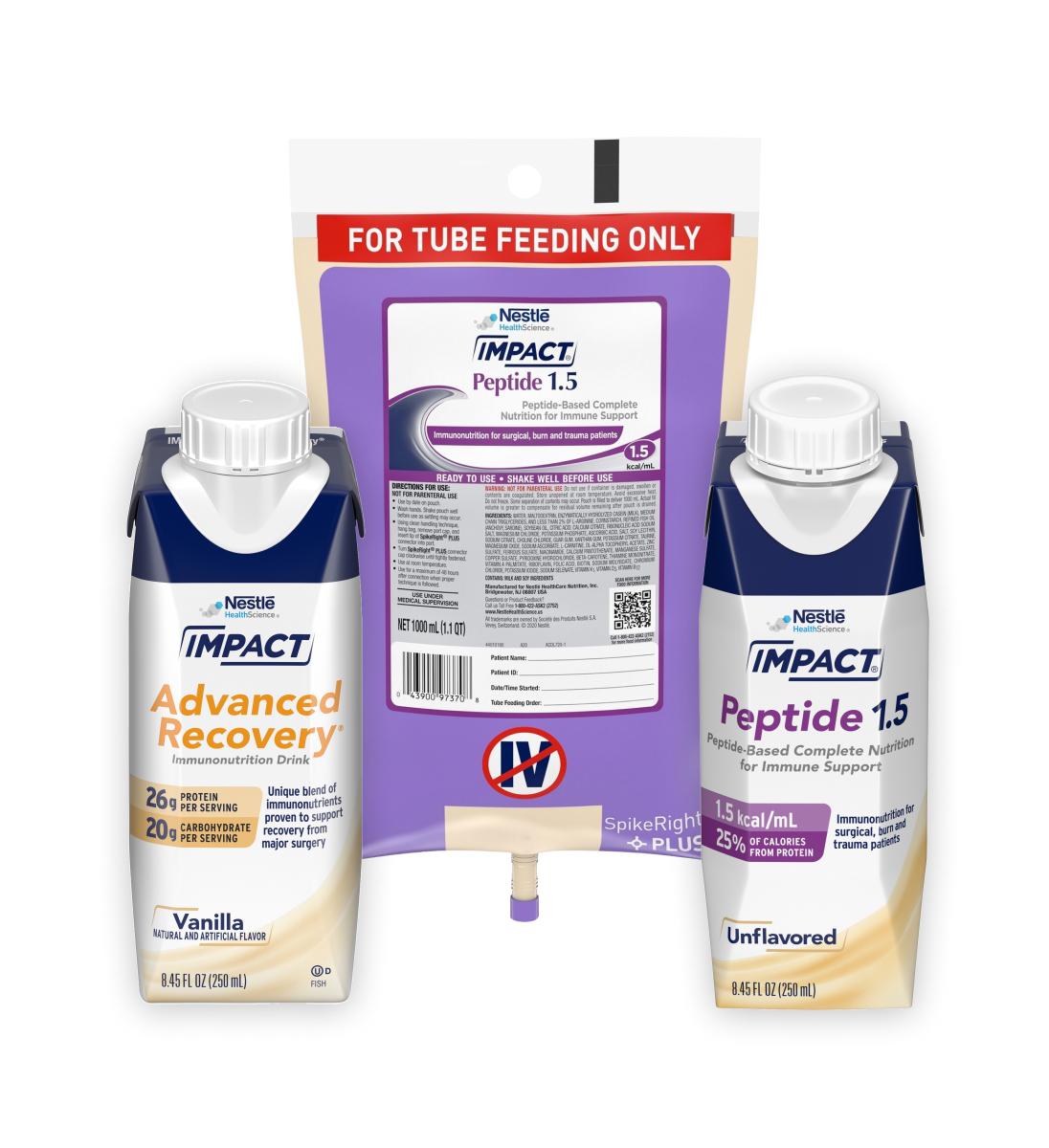
Immunonutrition containing L-arginine, n-3 fatty acids and nucleotides (IMPACT®) reduced the risk of surgical site and respiratory infections in patients having major elective surgery for cancer.
Immunonutrition vs. Standard Nutrition for Cancer Patients: A Systematic Review and Meta-Analysis
Yu K, Zheng X, Wang G, Liu M, Li Y et al. JPEN 2020; 44(5):742-767.
Objective
Determine efficacy for immunonutrition (IM) vs. standard nutrition by analyzing 61 RCTs studying patients (n=5983) having major elective surgery for cancer.
Methods
The majority of studies were enteral and involved various types of GI cancer surgery, however pulmonary and head & neck cancer surgery data were also included. IM formulas contained at least one supplemental immunonutrient.
The majority of enteral studies utilized formulas containing a blend of L-arginine, n-3 fatty acids and nucleotides (IMPACT®). Funnel plots and the Cochrane Risk of Bias assessment tool examined studies for risk of bias.
Results
Although differences in all-cause mortality and sepsis were not found, IM was associated with significantly reducing the risk of postoperative infectious complications (RR 0.71 [95% CI, 0.64-0.79]), including wound (RR 0.72 [95% CI, 0.60-0.87]), respiratory tract (RR 0.70 [95% CI, 0.59-0.84]) and urinary tract (RR 0.69 [95% CI, 0.51-0.94]) infections. A significantly decreased risk for anastomotic leak (RR 0.70 [95% CI, 0.53-0.91]) and reduced hospital stay (MD −2.12 days [95% CI −2.72 to −1.52]) was also observed.
Subgroup analyses were extensive and included a formula comparison by immunonutrient(s). Arginine + n-3 fatty acids + nucleotides were found to reduce the risk of surgical site and respiratory infections by 36% (p=0.000; see table) and 39% (p=0.001), respectively. This combination was also associated with a mean reduction in hospital stay of 3 days (p<0.00001).
Immunonutrient(s) | # Studies | n | Effect Est. | p-value |
|---|---|---|---|---|
n-3 fatty acids | 7 | 470 | 0.93 [0.57, 1.52] | 0.76 |
Glutamine | 3 | 597 | 0.80 [0.48, 1.33] | 0.38 |
Arginine + n-3 | 3 | 309 | 0.87 [0.37, 2.02] | 0.74 |
Arg + Gln | 2 | 93 | 0.65 [0.22, 1.92] | 0.43 |
Arg + n-3 + nucleotides | 23 | 2718 | 0.64 [0.50, 0.82] | 0.000 |
Arg + Gln + n-3 + nucleotides | 2 | 388 | 0.99 [0.40, 2.45] | 0.99 |
Adapted from Table 3
Other sub-analyses looking at nutritional status, duration and timing of IM, energy dose, enteral vs. parenteral, etc. were also completed. No suggestion of publication bias was found.
Provision of perioperative IM (5-7 days) containing supplemental L-arginine, n-3 fatty acids and nucleotides to malnourished surgical cancer patients via the GI tract and within total energy provision of 25-30 kcal/kg/d may provide the highest degree of clinical efficacy.