





























Blenderized Whole Food Formulas are Associated With Lower Healthcare Costs and Resource Use vs Standard Plant-Based Enteral Formulas
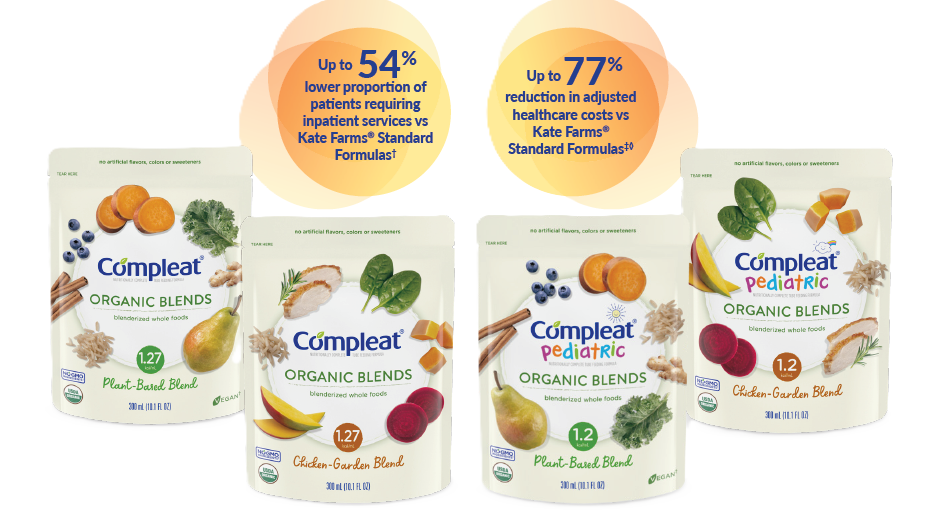
A retrospective, observational study of 1064 children and 448 adults in post-acute care settings associates healthcare resource utilization and cost benefits with blenderized whole food formulas compared to standard plant-based formulas.
Healthcare Resource Utilization and Cost Implications of Commercial Blenderized versus Plant-Based Standard Enteral Formulas in Children and Adults in Post-Acute Care: A Retrospective Study
A Research Summary based on: Bennett K, Desai A, Henrikson A, et al. ClinicoEconomics Outcomes Res. 2025 Nov 12;17:821-833.
Background and Study Objective
Enteral nutrition (EN) is the standard of care for patients with a functional gastrointestinal (GI) tract unable to meet nutritional requirements orally. Home enteral nutrition (HEN) provides life sustaining nutrition for post-acute care patients; however it may be associated with GI intolerance and other clinical complications, which may increase healthcare resource utilization (HCRU) and costs. There is a growing interest in both plant-based HEN as well as blenderized HEN; however, the comparative impact of these formula types on HCRU and costs has not yet been elucidated.
This study investigated the potential association between commercial blenderized tube feeding formulas (CBTF) and plant-based standard tube feeding formulas (STD-TF) and HCRU and costs in children and adults receiving HEN in a post-acute care setting.
Methods
Children (1-13 years) and adults (≥ 14 years) prescribed CBTF (Compleat® Pediatric Organic Blends/Compleat® Organic Blends Chicken-Garden or Plant Based Blends, Nestlé HealthCare Nutrition, US) or plant-based STD-TF (Kate Farms® Pediatric Standard 1.2 and Kate Farms® Standard 1.0 and 1.4, Kate Farms Inc., US) as sole source nutrition for ≥7 days after hospital discharge were included in the analysis. HCRU and associated costs were assessed at 12 weeks post discharge.
Study Design
- Retrospective
- De-Identified US claims data
- Observational
- Period between January 2018 and December 2020
Patients
Overall | CBTF | Plant-Based STD-TF | p-value | |
|---|---|---|---|---|
Children, n | 1064 | 469 | 595 | |
Mean Age, yrs (SD) | 5.05 (3.33) | 5.17 (3.32) | 4.96 (3.34) | 0.292 |
Adult, n | 448 | 124 | 324 | |
Mean Age, yrs (SD) | 41.55 (23.33) | 41.82 (23.90) | 41.45 (23.14) | 0.882 |
See Table 1 in manuscript for complete demographic and clinical characteristic data.
Study Results
Children and adults receiving CBTF had lower HCRU and costs compared to those receiving plant-based STD-TF in the post-acute care setting.
Results denoted with arrows are statistically significant (p≤0.05).
CBTF
Plant-Based STD-TF
Mean visits per patient were also significantly reduced in the CBTF vs STD-TF group for all visit types.
CBTF
Plant-Based STD-TF
Mean visits per patient were also significantly reduced in the CBTF vs STD-TF group for all visit types except emergency department visits.
CBTF
Plant-Based STD-TF
Adjusted for age, sex, and Charlson comorbidity index.
Discussion
- Existing evidence associates CBTF with reductions in GI intolerance symptoms, and several studies support the association of these clinical benefits to improved health economic outcomes.
- Future research is needed to assess the impact of CBTF on HCRU due to GI intolerance alone, and to assess confounders and generalizability.
The use of CBTF was associated with lower HCRU and costs in patients receiving EN in post-acute care as compared to plant-based STD-TF. These findings may guide formula selection based on economic impact.