





























Compleat® Pediatric Organic Blends formulas were associated with significant improvements in clinical and health economic outcomes.
In a retrospective study of 469 children in post-acute care diagnosed with digestive diseases, malnutrition, cerebral palsy, and seizure disorders, Compleat® Pediatric Organic Blends formulas were associated with significant reductions in GI intolerance symptoms, healthcare resource utilization, and associated costs as early as 28-days post-discharge.
Improvements in healthcare resource utilization were seen at all time points up to 168-days across multiple diagnoses as compared to the 1-year period before discharge (Pre-Index)
Chronic Conditions in Children Receiving Commercially Blenderized Tube Feeding Formula in the Post-Acute Care Setting: Real World Evidence of Clinical and Health Economic Outcomes
Henrikson A1, Desai A2, Allen F1, Yeddula S3, Araujo Torres K1
J Parenter Enteral Nutr. 2023;47(S2):S218.
1. Medical Affairs, Nestlé Health Science, 2. Market Access, Nestlé Health Science, 3. Clarivate Data Analytics & Insights
Objective
Describe clinical and health economic outcomes among pediatric patients diagnosed with chronic conditions, such as failure to thrive/malnutrition, diseases of the digestive system, cerebral palsy, and seizures, who received a commercially blenderized tube feeding (CBTF) formula.
Methods
A retrospective, observational study was conducted using nationally representative US claims data obtained from the Decision Resources Group Real World Evidence Data Repository, covering 98% of US health plans, including medical and pharmacy claims. Patient characteristics, diagnoses and comorbidities, concomitant medication use, gastrointestinal (GI) intolerance symptoms, healthcare resource utilization (HCRU), and cost of care were assessed in children (1-14 years) receiving a commercially blenderized tube feeding (CBTF) formula (Compleat® Pediatric Organic Blends, Nestlé HealthCare Nutrition, US) as sole source nutrition for ≥7 days in post-acute care between January 1, 2018 and December 30, 2020. The index date was defined as date of hospital discharge. GI intolerance and HCRU were compared in pre-index (within 1 year before discharge date) and post-index (last record in study period at 28-, 84-, and-168 days post-discharge) periods.
Results
The study included 469 children (44% female; mean age 5.2 [3.32] years) from all US regions receiving CBTF formula in a post-acute care setting.
Across all diagnoses and chronic conditions analyzed, significantly (p< 0.05) fewer patients experienced GI intolerance symptoms as early as 28-days post-discharge while receiving the CBTF formula compared to pre-discharge, and this reduction was maintained at 84- and 168-days post-discharge. Significant reductions in constipation, nausea and vomiting, abdominal pain, diarrhea, flatulence, gagging and retching, and abdominal distention were observed starting at 28-days post-discharge.
*Chi-square test (pre-index vs. post-index, alpha=0.05 level of significance)
Compared to pre-discharge, significantly (p< 0.05) fewer children diagnosed with diseases of the digestive system required inpatient (37% vs 9%) and emergency department visits (11% vs 3%) at 168-days post-discharge. Similarly, significant reductions in HCRU were observed for children diagnosed with malnutrition, cerebral palsy, and seizures. Mean outpatient visits were significantly decreased (p< 0.05) at 168-days post-index for children diagnosed with malnutrition (11 vs 5), diseases of the digestive system (15 vs 7), cerebral palsy (17 vs 7) and seizures (15 vs 6). Reductions in HCRU resulted in significant reductions in mean costs associated with outpatient visits.
Use of a commercially blenderized tube feeding formula among post-acute care children diagnosed with malnutrition, diseases of the digestive system, cerebral palsy and seizures was well tolerated and associated with significant reductions in GI intolerance symptoms. Significant reductions in HCRU and associated costs were observed, demonstrating the potential role of commercially blenderized tube feeding in improving clinical and health economic outcomes in children with chronic conditions.
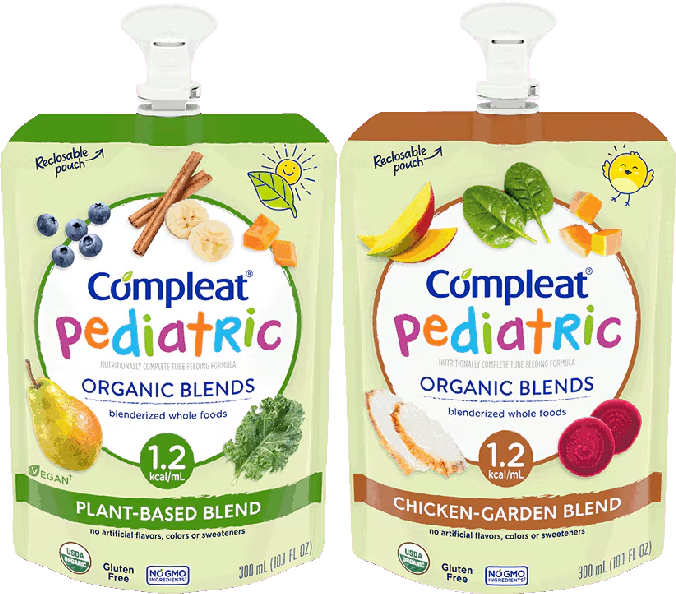
Compleat® Pediatric Organic Blends formulas, which include blenderized organic whole foods including mango, chicken, butternut squash, brown rice, beet, spinach, pears, blueberries, and kale are also associated with significant reductions in GI intolerance symptoms.