





























Association Between Changes in Protein Intake and Risk of Cognitive Impairment:
A Prospective Cohort Study
Xu, X.; Yin, Y.; Niu, L.; Yang, X.; Du, X.; Tian, Q.
Nutrients 2023, 15, 2.
Objective:
To investigate the associations between the change in protein intake from various food groups and cognitive impairment among older adults in a prospective cohort study.
Materials and Methods:
A total of 6951 participants without cognitive impairment or dementia were included in this prospective cohort study. Participants were selected from older adults enrolled in the population-based cohort study titled the CLHLS, a nationwide prospective cohort study in China that enrolled individuals aged 65 and older. The investigators included participants who had normal cognitive function at baseline.
Measurement of Protein Intake:
Trained personnel collected information on protein food groups that are commonly consumed in China via the simplified food frequency questionnaire (FFQ). The protein groups were divided into two categories, including animal-based protein food groups (eggs, fish/aquatic products, meats, and milk and dairy products), and plant-based protein food groups (bean products, nuts). Food frequency was measured by five options, ranging from “almost every day” to “rarely or never.” Follow-up scores minus baseline scores were identified as changes in protein intake. The absolute change scores of protein intake were calculated using protein intake at baseline and the first follow-up.
Cognitive Assessment:
Cognitive impairment was measured by the Chinese version of the Mini-Mental State Examination (MMSE), a reliable and valid tool for measuring cognitive function among older Chinese adults. The Chinese MMSE measured five aspects of cognitive function (orientation, reaction, attention & calculation, recall, and language) by 24 items. The total score ranged from 0 to 30, and a higher score indicated better cognitive function.
Covariates:
Demographic variables, chronic medical conditions, and physical performance are associated with cognitive function in older adults. All multivariate models included the following covariates: age at enrollment, sex, educational level (years of education), residence (urban, rural), socioeconomic status (favorable, unfavorable), marital status (married, divorced/widowed/never), living pattern (living with family members, alone or at nursing home), current smoking behavior (yes, no), current alcohol use (yes, no), current regular physical exercise condition (yes, no), activity of daily living (ADL), the instrumental activity of daily living (IADL), body mass index (BMI), and chronic medical illness including hypertension, diabetes, heart disease, stroke or cardiovascular disease (CVD), cataract, digestive system diseases, arthritis, and Parkinson’s disease.
Statistical Analysis:
Descriptive statistics were used to summarize the baseline characteristics. “Person-years” were calculated from the time of the baseline survey of participants to the earliest of the following events: the first occurrence of cognitive impairment, death; lost to follow-up, or time of the last survey. Demographic variables, functional ability, and chronic medical illness were listed as possible covariates. The association between changes in protein intake and cognitive impairment was investigated in three models. Model 1 adjusted for sex and age, Model 2, further adjusted for residence, years of schooling, marital status, economic status, living pattern based on Model 1, and Model 3, further adjusted for smoking, alcohol drinking, ADL, IADL, BMI, and chronic disease (hypertension, diabetes, heart disease, stroke or CVD, cataract, digestive system diseases, arthritis, and Parkinson’s disease) based on Model 2. The investigators also performed stratified analyses to evaluate potential effect modifications by baseline age, sex, residence, socioeconomic status, living pattern, current regular physical exercise condition, IADL disability, and BMI.
Results:
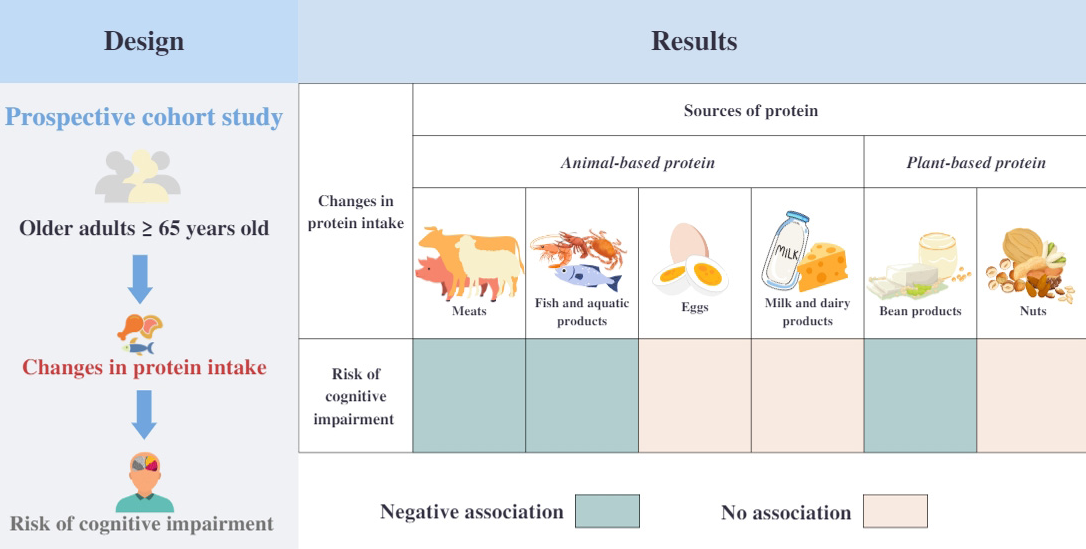
During the 37,535 person-years of follow-up, 1202 (17.3%) participants developed cognitive impairment. Mean age was 79.7 ± 10.3 years old at baseline, and males accounted for 49.7% of total participants. There were significant differences in change in protein intake (total, animal, and plant) between the two groups with p values of <0.001, 0.001, and 0.005, respectively. Change in animal-based protein intake was correlated to the risk of cognitive impairment. Compared with participants with stable change, those with an extreme decline in animal-based protein intake had a 48% higher risk of cognitive impairment with HR of 1.48 (95% CI = 1.15–1.91, p = 0.002).
In the animal-based protein group, only the change in fish/aquatic products was non-linearly correlated to the risk of cognitive impairment. Compared to participants with stable change, only those with extreme decline in fish/aquatic products intake had a 50% higher risk of cognitive impairment with HR of 1.50 (95% CI = 1.16–1.93, p = 0.002). In the plant-based protein group, both changes in bean products and nut intake were non-linearly correlated to the risk of cognitive impairment. For the change in bean products intake, compared to participants with stable intake, participants with extreme and moderate decline in intake had a higher risk of cognitive impairment with HRs of 1.37 (95% CI = 1.09– 1.72, p = 0.006), and 1.26 (95% CI = 1.01–1.58, p = 0.038), respectively. For the change in nut intake, compared to participants with stable intake, participants with mild decline, mild improvement, and moderate improvement in intake had a lower risk of cognitive impairment with HRs of 0.81 (95% CI = 0.67–0.97, p = 0.025), 0.70 (95% CI = 0.56–0.87, p = 0.001), and 0.58 (95% CI = 0.44–0.77, p <0.001), respectively
Conclusion:
In conclusion, among Chinese older adults, a negative association was observed between improvement in protein intake and risk of cognitive impairment, and extreme decline in protein intake increased the risk of cognitive impairment. The investigation highlights the role of improvement and decline in protein intake on cognitive performance in older adults. In addition, the impact of protein intake from different food groups on cognitive function may be affected by the characteristics of older adults. Clinical trials modifying significant protein intake should be conducted to improve the cognitive function of older adults.
The complete study may be accessed at: Nutrients | Free Full-Text | Association between Changes in Protein Intake and Risk of Cognitive Impairment: A Prospective Cohort Study (mdpi.com)
Study summary prepared by Nestlé Health Science. All trademarks are owned by Société des Produits Nestlé S.A., Vevey, Switzerland. ©2023 Nestlé Health Science. All rights reserved.