





























Variability in osmolality analytical methodology and reporting underscores the need for standardization and clinician awareness to enable meaningful comparisons across enteral nutrition formulas
A study comparing osmolality of common peptide-based enteral formulas using vapor pressure osmometry, a standard analytical methodology, identified differences compared to published values.
Apples to Osmoles? Differences in Osmolality Reporting for Enteral Formulas and Implications for Clinical Interpretation
A Research Summary based on: Poster #P53 at ASPEN26 Nutrition Science and Practice Conference, February 14-17, 2026, Long Beach, California. J Parenter Enteral Nutr. 2026; 50: S71-S332.
What is Osmolality?
- Osmolality is the concentration of free particles in solution, reported as mOsm/kg H2O
- Macro- and micronutrients, including fruit and vegetable ingredients, as well as the size (i.e., smaller size) of particles, contribute to enteral nutrition osmolality
If considering osmolality in enteral nutrition formula selection, clinicians should be aware of variability in analytical testing and reporting practices that may limit meaningful comparisons of osmolality across formulas and manufacturers.
While some differences in osmolality may be expected due to analytical variability, formula homogeneity, storage conditions, and changes over shelf life, larger magnitude variability may lie outside anticipated discrepancies.
Why Was This Study Done?
- Osmolality is the concentration of free particles in solution1,2
- Reported enteral nutrition (EN) formula osmolality is typically 280-875 mOsm/kg H2O
- Despite common perception, there's little evidence to suggest that higher EN osmolality alone causes gastrointestinal (GI) intolerance / diarrhea1,3,4
- Yet, clinicians often use osmolality as a factor when choosing EN, particularly for patients transitioning to peptide formulas with previous intolerance to standard EN
- Thus, variability in analytical methodologies and reporting practices may limit clinical utility of osmolality comparisons
This study aimed to compare osmolality of common pediatric and adult EN peptide-based formulas using standard methodologies5-8 to assess variability across formulas with different ingredients, caloric densities, and manufacturers.
How Was This Study Performed?
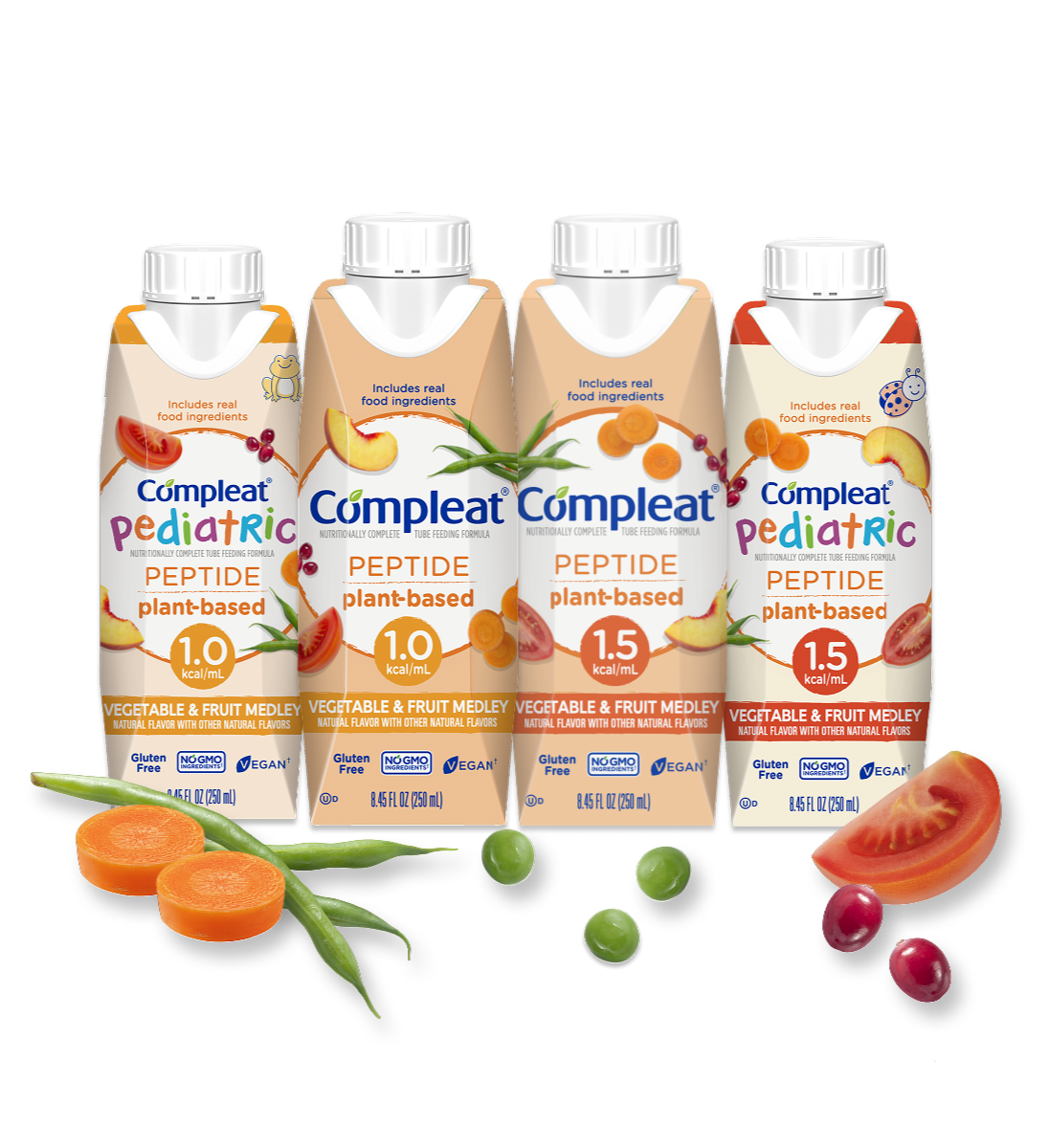
- Nine commercially available pediatric and adult plant-based peptide-based (PBP) formulas were identified:
- FV-PBP: including fruit and vegetable ingredients (Compleat® Peptide formulas, Nestlé Healthcare Nutrition, US); n=4
- W-PBP: without fruit and vegetable ingredients (Kate Farms® Peptide formulas, Kate Farms Inc, US); n=5
- Measured osmolality was determined using vapor pressure osmometry (Vapro® Vapor Pressure Osmometer, Wescor Model 5600), which is recommended for products with osmolality 100-3,000 mOsm/kg H2O or increased viscosity and has been adopted as an industry standard for medical foods internationally5-8
- Samples were tested in triplicate with averages compared to osmolality values published on manufacturer websites
- Based on prior reporting,8 additional samples diluted 1:1 with 200 mOsm/kg H2O NaCl solution were measured to assess impact of dilution
- A secondary analysis was performed using the same methodology as described to evaluate non-plant-based peptide formulas (N-PBP) (Abbott Nutrition; Vital® 1.5 and Vital® HP 1.0)
Study Results
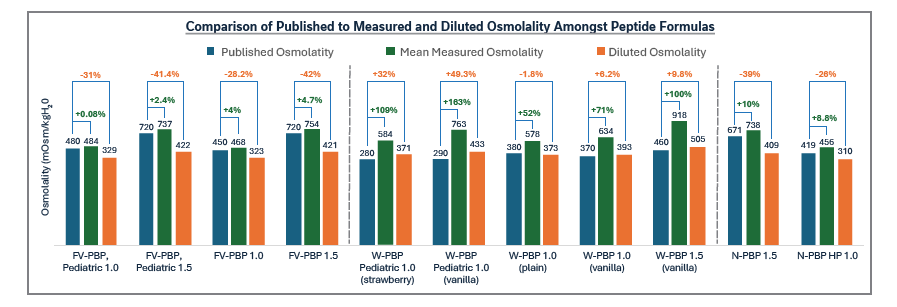
- For FV-PBP, measured osmolality was 0.08-2.4% higher and 4-4.7% higher for pediatric and adult formulas, respectively
- For W-PBP, measured osmolality was 109-163% higher and 52-100% higher for pediatric and adult formulas, respectively
- For N-PBP, measured osmolality was 8.8-10% higher than published osmolality
- Use of diluted samples increased the variability for FV-PBP and N-PBP but decreased variability for W-PBP
- Differences in measured versus published osmolality were greater for products with higher caloric density
Discussion and Future Directions
- Notable differences were observed for W-PBP, with measured osmolality more than two-times higher than published in three of five samples
- Although minor discrepancies may be expected due to analytical variability, formula homogeneity, storage conditions, and shelf-life changes, differences of 200-400 mOsm/kg H2O would not be anticipated; formula dilution did not fully explain the differences
- For FV-PBP, measured osmolality compared to published osmolality was within 5% of all formulas, suggesting good agreement
- Future research may focus on expanding analysis on additional EN formulas
This analysis underscores the need for standardized methodology and reporting practices to enable meaningful comparisons of osmolality across EN formulas. Clinicians should remain aware of differences when considering osmolality as part of formula selection.