

















Use of Alfamino® formula in infants with CMPA is safe and associated with high caregiver satisfaction.

A post-market surveillance study (PMSS) with a commercialized hypoallergenic amino acid-based formula (HAA)1,2 to evaluate safety and use in routine clinical practice settings. At each follow-up visit, caregiver satisfaction with Alfamino® Infant formula was assessed.3
Prospective Surveillance of an Amino Acid-Based Infant Formula in Infants with Cow’s Milk Protein Allergy in a Routine Clinical Practice Setting
Cekola P, Henrikson A, Reichert H, Cohen SS, Huhmann MB et al.
Safety and Usage of an Amino Acid-based Formula for Infants: Results from a Post Market Surveillance Study.
J Clin Nutr Diet 2021 Vol.7 No.8:2
Background
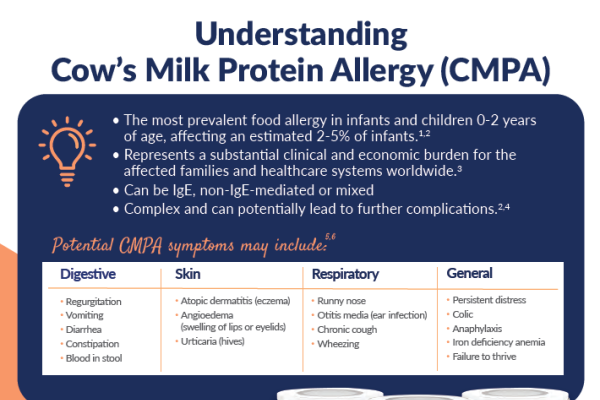
Cow’s milk protein allergy (CMPA) is the most common food allergy in infants. Amino acid-based (AA) formulas are commonly used in the management of CMPA. The American Academy of Pediatrics defines clinical documentation of infant growth and hypoallergenicity required for commercialization of AA formulas in the United States (US).
Objective
To evaluate safety and use in routine clinical practice settings, a post-market surveillance study (PMSS) with a commercialized hypoallergenic AA formula (HAA) was conducted.
This was the first such study with an AA infant formula.
Materials and Methods
This prospective, PMSS was conducted February 2017 – May 2018 at 30 U.S. sites. Subjects diagnosed with CMPA were included in this analysis.
- Enrollment was open for 14 months. Caregiver consent was obtained for infants meeting the inclusion criteria: ≤12 months of age, >37 weeks corrected gestation age at enrollment and planned use of HAA.
- There were no mandated clinic visits; subjects were followed by their healthcare providers (HCP) as per usual care.
- Data was collected for 4 months after enrollment or until discontinuation of formula. Complementary food intake (CFI) and AA caregiver satisfaction were assessed at medical visits.
Results
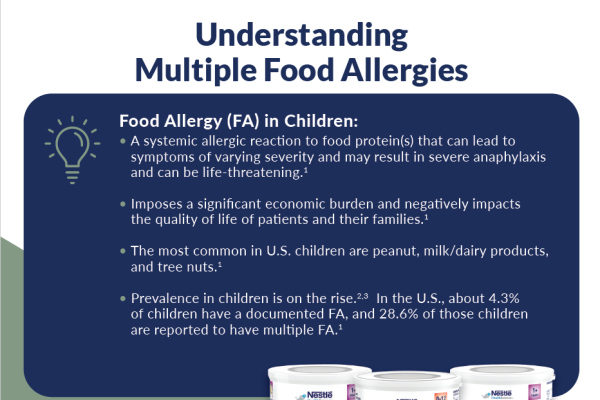
- 144 infants were enrolled, 100 (69%) with CMPA diagnosis.
- 84% of subjects with CMPA had severe CMPA based on protocol criteria: history of anaphylaxis, or failure of extensively hydrolyzed formula to resolve symptoms or physician judgement.
- Six serious adverse events reported in 6 subjects (3 with severe CMPA); all were unrelated (5 of 6) or unlikely (1 of 6) related to HAA.
- Total of 125 adverse events (AE) were reported in 43 subjects (26 with severe CMPA). Most AE were reported as unrelated (78%) or unlikely (10%) related to HAA; the 9% AE reported as probable related to HAA, frequently listed emesis or constipation as the event.
FTT, failure to thrive.
Figure from the 2022 study summary of the full study cohort (all 144 enrolled infants). The adverse event results listed above are for the 100 infants with CMPA.
- No anaphylaxis reported during the study.
- Overall, 71% had CFI including cereal [99%, first intake mean age 6.0 mo]; dairy [20%, 8.9 mo]; single fruit/vegetable [75%, 7.5 mo]; animal protein [30%, 9.6 mo]. Twelve subjects (12%) had a documented reaction to complementary foods. Eighty-two percent of caregivers indicated satisfaction with HAA.
*Additional 16 subjects with no data
A prospective surveillance program outside of a controlled clinical trial indicated HAA use in infants with CMPA was safe and associated with high caregiver satisfaction.
Alfamino® is specifically formulated with medium-chain triglycerides (MCT) to facilitate fat absorption4,5
*PurAmino® is indicated for 0-24 months of age.